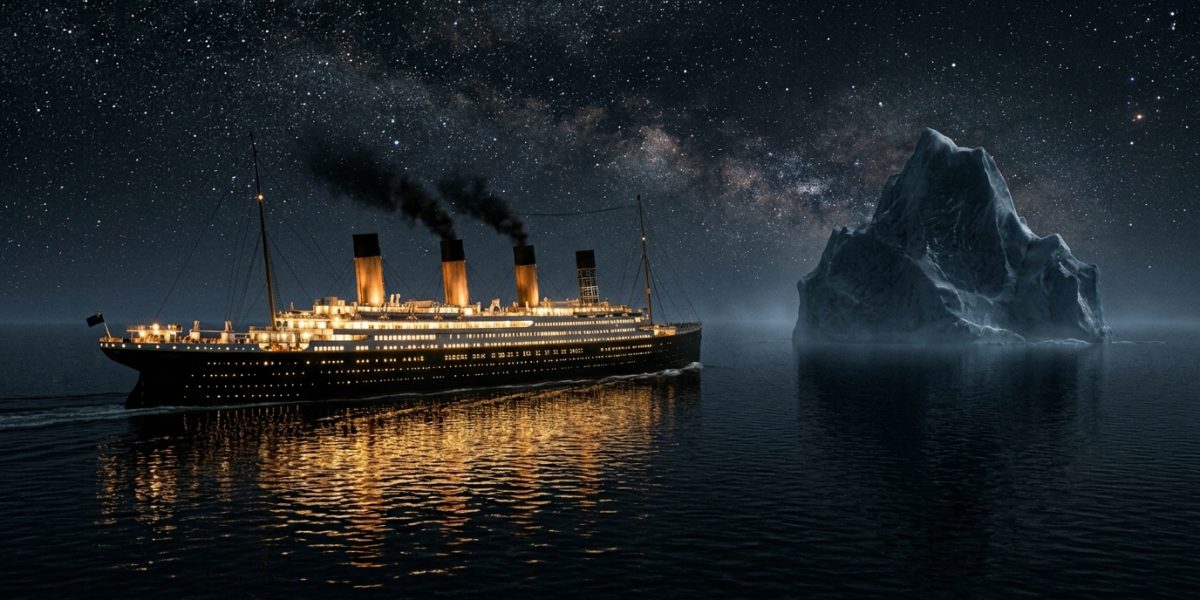
At 11:40 PM on April 14, 1912, lookout Frederick Fleet spotted a dark mass directly ahead of the Titanic and rang the crow’s nest bell three times. Thirty-seven seconds later, the iceberg tore a 90-meter gash along the ship’s starboard hull below the waterline. The unsinkable ship had less than three hours to live.
The 37 Seconds That Sealed the Titanic’s Fate
Fleet called the bridge: ‘Iceberg, right ahead.’ First Officer William Murdoch ordered ‘Hard-a-starboard’ — the old command meaning turn left — and reversed the engines. But 47,000 tons of ship traveling at 22.5 knots cannot turn or stop in 37 seconds. The collision was inevitable from the moment the iceberg was spotted.
Later analysis showed the evasive maneuver may have actually worsened the damage. If Murdoch had aimed directly at the iceberg, a head-on collision would have crumpled the bow but likely kept the ship afloat. The glancing blow breached multiple watertight compartments instead of just one or two.
| Time (Ship’s Clock) | Event | Significance |
| 11:40 PM | Iceberg spotted by Fleet | 37 seconds to collision |
| 11:40:37 PM | Iceberg strikes starboard hull | Watertight compartments begin flooding |
| 11:50 PM | Captain Smith notified | Damage assessment begins |
| 12:05 AM | Lifeboats ordered uncovered | 49 minutes after collision |
| 12:45 AM | First lifeboat launched | Capacity 65, left with 28 people |
| 2:20 AM | Titanic sinks completely | 2 hours 40 minutes after collision |
Why the Titanic Carried Too Few Lifeboats
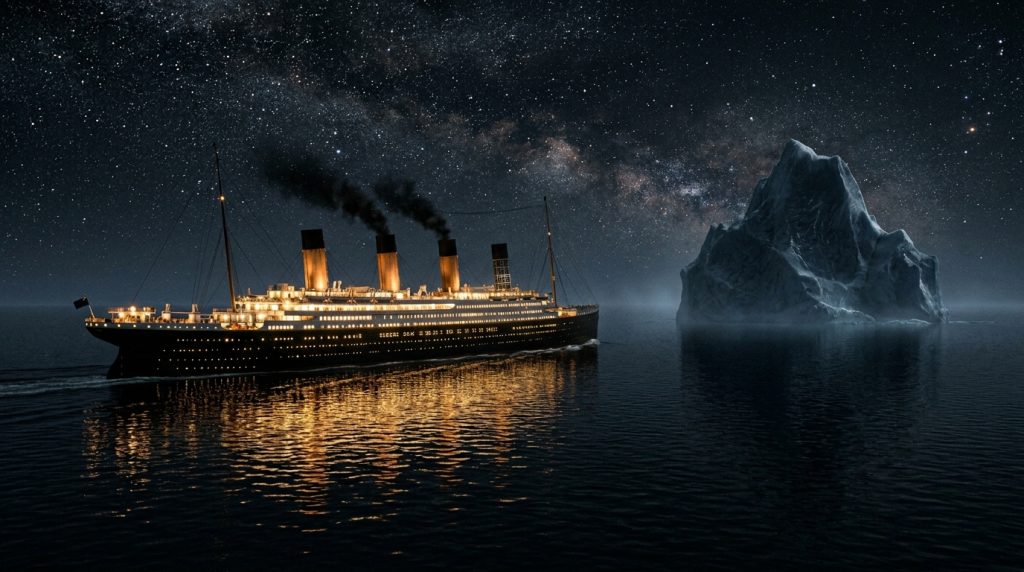
The Titanic carried 20 lifeboats with a total capacity of 1,178 people. There were 2,224 people aboard. Even if every lifeboat had been filled to capacity — which none were on that night — over 1,000 people would have had no place to go.
This was legal. British Board of Trade regulations set lifeboat requirements based on ship tonnage, not passenger count. The regulations had not been updated since 1894. The Titanic actually exceeded the legal requirement. The regulation was never designed for ships of this size.
| Lifeboat Fact | Number | Context |
| Total lifeboats carried | 20 | Exceeded legal minimum of 16 |
| Total capacity | 1,178 people | Only 53% of total aboard |
| Actual people saved | 710 | Just 32% of total aboard |
| Average loading per boat | 35.5 people | Capacity was 58–65 per boat |
| First boat launched (capacity 65) | 28 people | Officers feared panic, under-filled |
The Radio Messages Nobody Acted On
Throughout April 14, the Titanic received at least six ice warnings from other ships in the area. The California had warned of a massive ice field directly in the Titanic’s path and stopped for the night. The Titanic’s radio operators — employed by Marconi, not White Star Line — were busy clearing a backlog of passenger messages and sent back an irritated reply: ‘Keep out. Shut up. I am busy.’
The California, just 10–20 miles away when the Titanic sank, had turned off its radio for the night. Its crew saw rockets in the distance but interpreted them as company signals. When they finally understood what had happened, the Titanic was gone.
The Human Cost by Class
| Passenger Class | Aboard | Survived | Survival Rate |
| First Class | 325 | 202 | 62% |
| Second Class | 285 | 118 | 41% |
| Third Class | 706 | 178 | 25% |
| Crew | 908 | 212 | 23% |
| Total | 2,224 | 710 | 32% |
❓ Frequently Asked Questions (FAQ)
How long did it take the Titanic to sink?
Exactly 2 hours and 40 minutes — from the collision at 11:40 PM on April 14 to the final sinking at 2:20 AM on April 15, 1912.
Why didn’t other ships rescue Titanic survivors faster?
The Carpathia, the nearest ship responding to distress signals, was 58 miles away and arrived at 4:10 AM — nearly two hours after the Titanic sank. The California, far closer, had turned off its radio.
Where is the Titanic wreck located today?
The wreck lies approximately 3,800 meters deep in the North Atlantic Ocean, about 600 km south-southeast of Newfoundland, Canada. It was discovered in 1985 by Robert Ballard.
How cold was the water when the Titanic sank?
The water temperature was approximately -2°C (28°F). Hypothermia would incapacitate most survivors within 15–30 minutes, causing death within 30–90 minutes.
How many children died on the Titanic?
Of 109 children aboard, 52 died — a survival rate of 52%. However, survival rates varied dramatically by class: all 29 first and second-class children survived, while 23 of 79 third-class children perished.