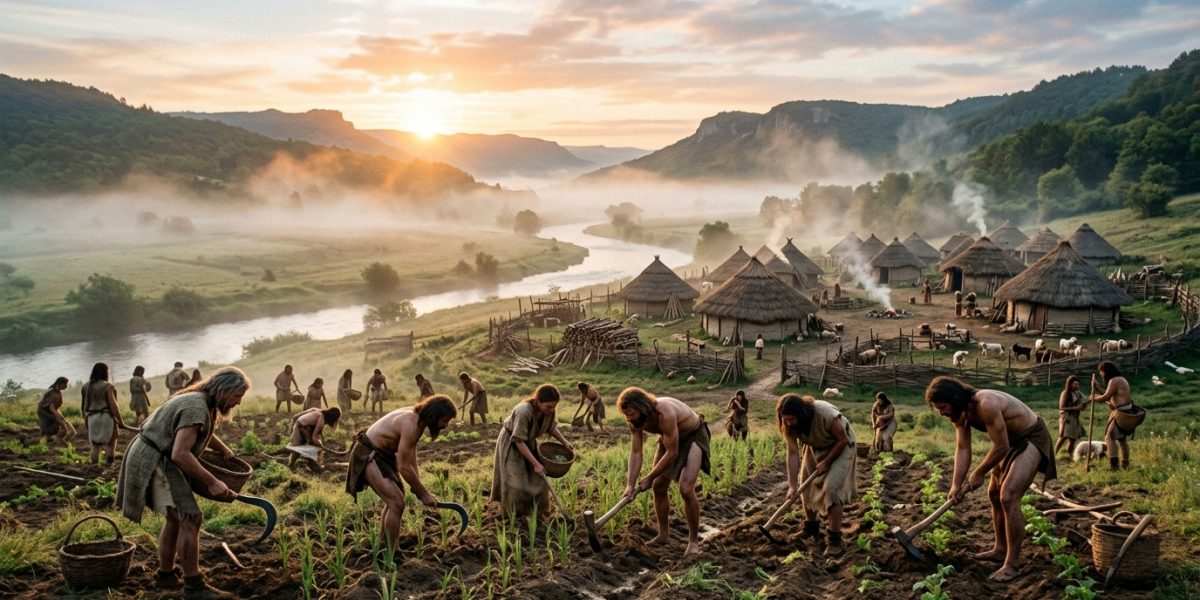
For 300,000 years, humans walked. We followed animals, chased seasons, and carried everything we owned. Then, in the Fertile Crescent approximately 12,000 years ago, something changed that would alter human biology, social structure, health, and the trajectory of every civilization that followed. We stopped. We planted. And nothing was ever the same.
What Triggered the Agricultural Revolution
The shift from nomadic hunter-gatherer to settled farmer was not a single decision — it was a gradual process driven by climate change, population pressure, and environmental depletion. The end of the last ice age around 11,700 BCE created warmer, wetter conditions that made wild grain harvests more abundant, encouraging people to return to the same locations season after season.
Eventually, returning to the same place became staying. Staying became planting. Planting became storing. Storing became property. Property became defense. Defense became hierarchy. The entire structure of civilization emerged from that first planted seed.
| Era | Approximate Date | Key Development | Population Estimate |
| Late Paleolithic | 70,000–12,000 BCE | Mobile hunter-gatherers, sophisticated tools | 1–5 million globally |
| Pre-agriculture | 12,500–10,000 BCE | Semi-sedentary, harvesting wild plants | 5–8 million globally |
| Early Neolithic | 10,000–7,000 BCE | First cultivation, permanent villages appear | 8–15 million globally |
| Advanced Neolithic | 7,000–4,000 BCE | Irrigation, animal domestication, trade | 15–50 million globally |
| Bronze Age | 4,000–1,200 BCE | Cities, writing, organized states emerge | 50–100 million globally |
What We Gave Up: The Paradox of Progress
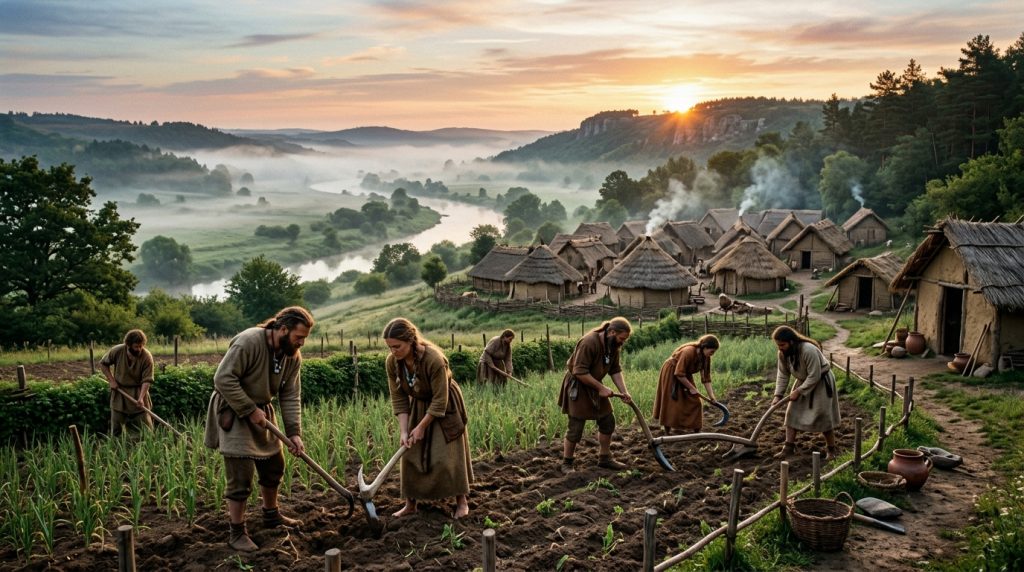
Hunter-gatherers were, in many measurable ways, healthier than early farmers. Skeletal analysis shows that with the shift to agriculture, average height decreased by 15cm, bone density dropped, dental cavities increased dramatically, and signs of nutritional deficiency (particularly iron and vitamin B) appeared in population skeletons for the first time.
The reason: farming produced more calories but less nutritional diversity. A diet of primarily wheat or rice is calorie-dense but lacks the protein variety, micronutrients, and variety of a mixed hunter-gatherer diet. Jared Diamond famously described agriculture as ‘the worst mistake in the history of the human race’ — not because it wasn’t necessary, but because the trade-offs were severe and underacknowledged.
| Health Metric | Hunter-Gatherers | Early Farmers | Change |
| Average height (male) | ~175cm | ~160cm | −15cm (−9%) |
| Dental cavities | Rare (<5% of teeth) | Common (20–40% of teeth) | 400–800% increase |
| Bone density | High | Reduced | Significant decrease |
| Working hours/day | 4–6 hours | 10–14 hours | Nearly doubled |
| Diet diversity | ~80–200 species | ~5–10 main crops | 95% reduction |
| Life expectancy | ~35 years* | ~25–30 years | Decreased |
*Note: Low ancient life expectancy reflects high infant mortality; those who survived childhood often lived into their 50s and 60s.
What We Gained: The Architecture of Civilization
Agriculture produced surplus. Surplus produced storage. Storage produced the need for accounting — the earliest writing systems (Sumerian cuneiform, ~3200 BCE) were grain receipts, not literature. Surplus also freed a portion of the population from food production for the first time, enabling specialization: priests, soldiers, craftsmen, merchants.
The first cities — Çatalhöyük, Jericho, Uruk — were only possible because agriculture could feed dense populations in a fixed location. From these settlements came architecture, law, religion, philosophy, mathematics, and eventually, the civilization that would produce rockets, literature, and artificial intelligence.
Why This Story Goes Viral on Discover
The agricultural revolution story hits the Discover triggers precisely because it reframes something people think they understand (farming = progress) with a counterintuitive perspective (farming made early humans sicker and worked harder). This cognitive dissonance is a core driver of content sharing — people share what surprises them and changes how they see the world.
❓ Frequently Asked Questions (FAQ)
When exactly did humans start farming?
The earliest evidence of intentional crop cultivation dates to approximately 10,000–9,500 BCE in the Fertile Crescent (modern-day Iraq, Syria, Turkey, and Israel). Independent agricultural origins also emerged in China (8,000 BCE), Mesoamerica (7,000 BCE), and New Guinea (7,000 BCE).
What was the first crop humans cultivated?
Emmer wheat and einkorn wheat are among the earliest cultivated crops, along with barley, lentils, and peas. In the Fertile Crescent, these ‘founder crops’ formed the basis of the first agricultural communities.
Did humans around the world all start farming at the same time?
No. Agriculture developed independently in at least 7–11 different locations around the world over a span of several thousand years. The Fertile Crescent (10,000 BCE), Yellow River Valley in China (7,000 BCE), and Central Mexico (5,000–7,000 BCE) are among the most significant independent origins.
Why did hunter-gatherers switch to farming if it made them less healthy?
Population pressure and environmental depletion of wild resources made the hunter-gatherer lifestyle less viable over time. Farming could support 10–100 times more people per square kilometer, making it a demographic necessity even if the quality of life decreased for individuals.
How did the agricultural revolution lead to inequality?
Fixed land creates ownership. Ownership creates inheritance. Inheritance creates generational wealth gaps. The first evidence of wealth inequality in human populations — seen in burial richness and skeletal differences between individuals — appears with the onset of settled agricultural communities, not before.
Is there any group of people still living as hunter-gatherers today?
Yes, though very few. Groups including the Hadza in Tanzania, the Ju/’hoansi San in Botswana and Namibia, and some communities in Papua New Guinea continue aspects of traditional hunter-gatherer lifestyles. These communities have been extensively studied and provide the best living window into pre-agricultural human existence.


